
The Danger of Google Ads Smart Bidding
18 March 2026Apologies in advance if this is a somewhat cynical perspective of Google Ads smart bidding. However after managing Google Ads search campaigns for dozens of Australian businesses, conducting tests for multiple clients, and comparing results across large datasets over time, I have come to a stark realisation:
Smart Bidding Is Not Your Friend
You see, Google’s smart bidding does not maximise your profit. It maximises Google’s profit. Think about it. You give Google full control over every keyword in your Google Ads account, with the belief that Google’s AI will somehow deliver your business with an advantage over your competitors.
But why should it? And how can it?
It’s important to understand that if Google manages your campaigns, Google probably also manages the campaigns of your competitors. If multiple businesses are chasing the same customers, and one business gains a customer, it must be at the expense of another business.
Google search, at it’s limit, is therefore a zero-sum game, where one advertiser gaining a click or sale means another advertiser losing that click or sale. It is therefore by definition impossible for Google to deliver an optimum outcome for all advertisers at the same time, meaning that Google must choose between businesses in which to prioritise. And it does this with a price discrimination strategy which maximises Google profits: smart bidding.
Smart Bidding Allows Price Discrimination
Smart bidding provides Google with the power to manage spending for multiple businesses competing for the same customers, providing Google with considerable leverage to control pricing and traffic volume for each advertiser. With this power, it is reasonable to assume that Google will choose the set of outcomes which yield the highest collective profit for Google.
All things equal, the more a business pays for a Google click, the higher Google’s profit, so the closer the click price to the business’s limit (i.e. their break-even point), the greater Google’s profit.
Charging each business the maximum amount they are willing to pay is known as first-degree price discrimination. It is highly profitable, but requires perfect information, usually making it difficult to implement in practice. But with smart bidding, Google can get very close.
To see how this works, let’s suppose there are 3 businesses advertising on Google before smart bidding (see graph below):
- Advertiser A is paying $5 click costs per sale and receives $10 in revenue, making $5 profit per sale.
- Advertiser B is paying $5 click costs per sale and receives $14 in revenue, making $9 profit per sale.
- Advertiser C is paying $10 click costs per sale and receives $14 in revenue, making $4 profit per sale.
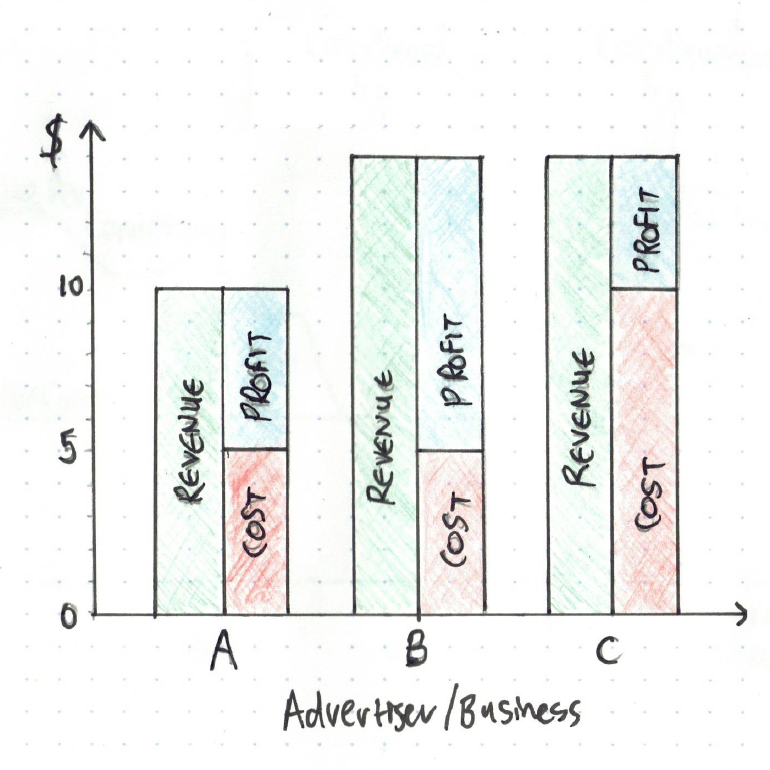
Since advertisers A and B are both paying $5 for clicks, but advertiser C is paying $10, Google will deliver a higher volume of clicks to advertiser C:
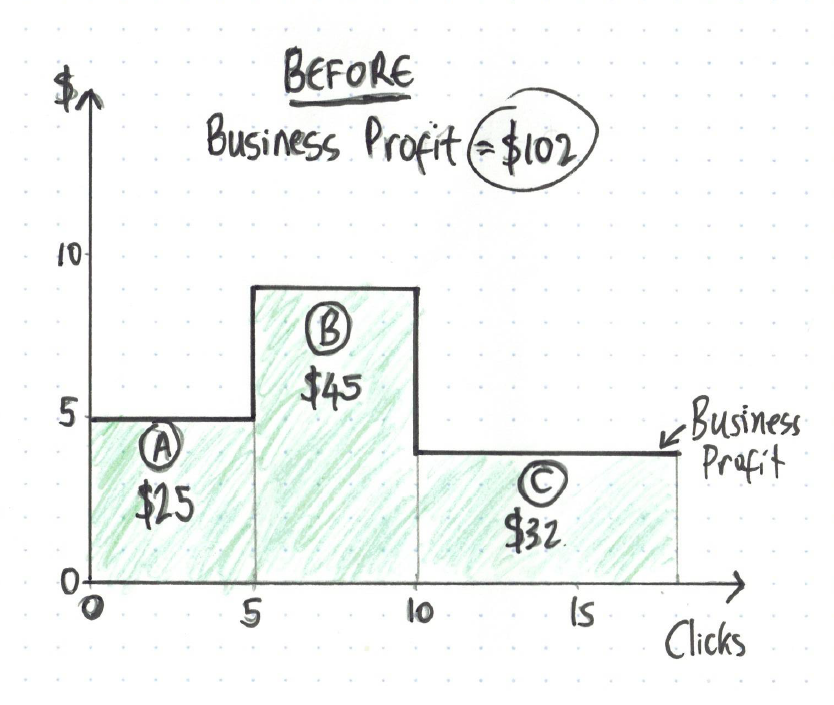
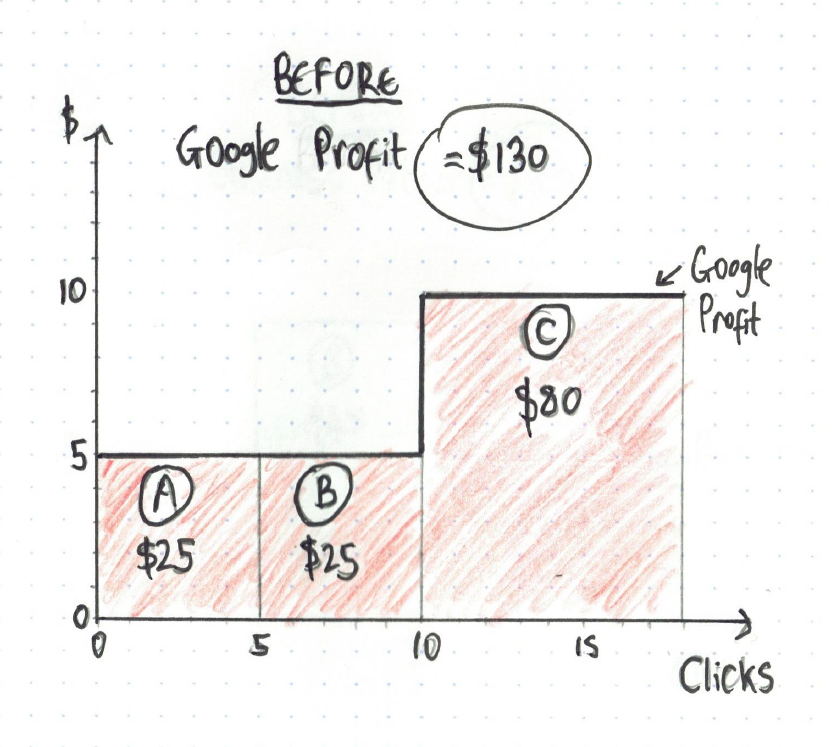
In the graph above, advertiser A and B both get 5 clicks, while advertiser C gets 8 clicks. Multiply this by each advertiser’s profit margin (from the first graph), and the combined profit for the 3 businesses is $102, and multiply click volume by click costs, and Google’s profit is $130 (see below):
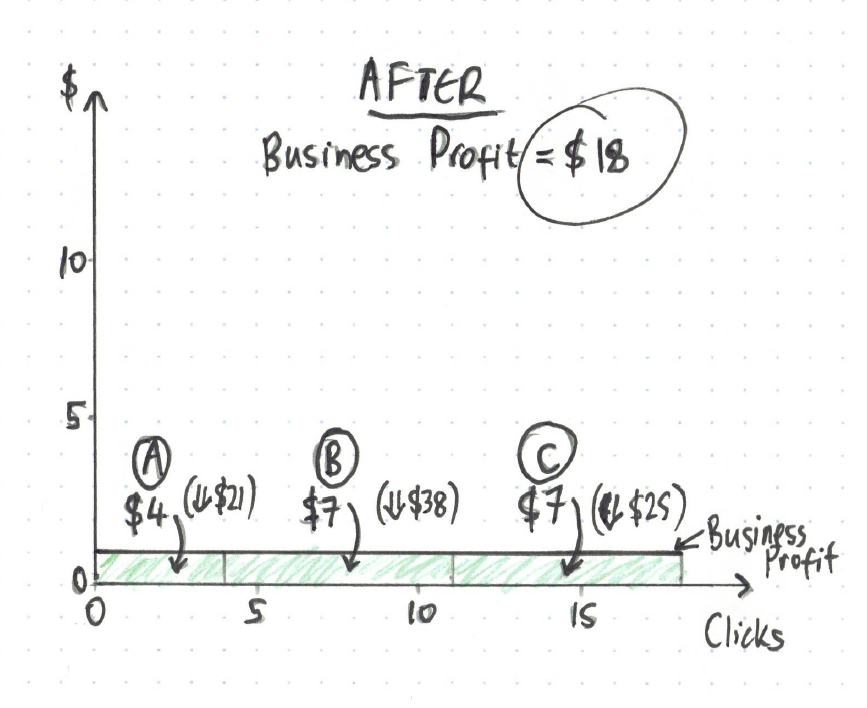
Now let’s consider a scenario where the 3 businesses set a ‘target cost per conversion’ bid using Google Ads smart bidding, which causes their cost per conversion to increase and stabilise close to their break even point. Revenue per sale is exactly the same, but cost per sale has risen due to the higher cost per conversion, reducing the blue profit area significantly:
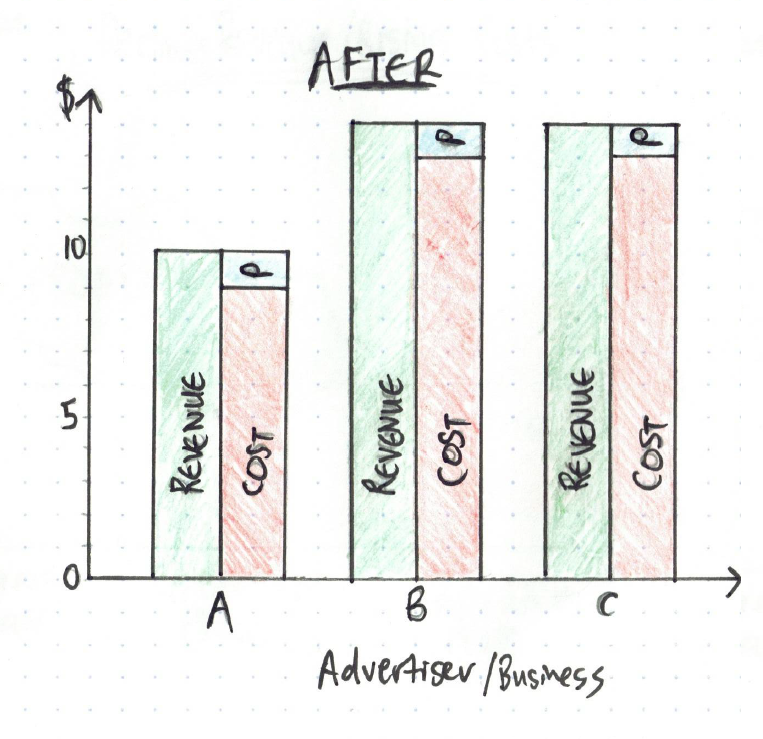
The combined profit for the 3 advertisers has fallen 82% from $102 to $18:
While Google’s combined profit has increased 48% from $130 to $192:
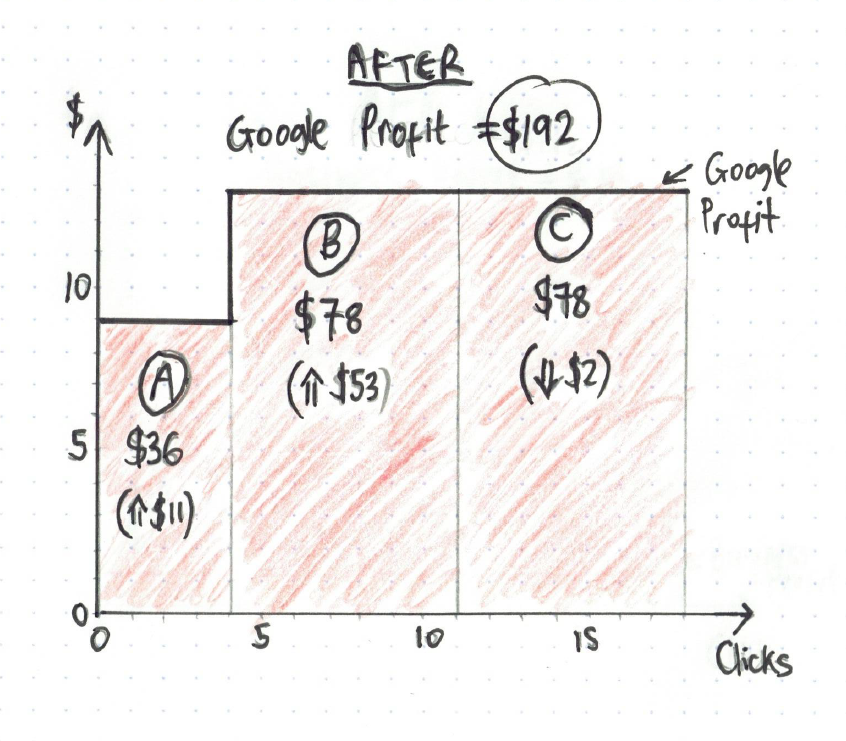
What is interesting here is that total combined market profit (i.e. Google profit + advertisers’ profit) has fallen 10% from $232 to $210, so from a marginal utility perspective, smart bidding has actually reduced overall economic value.
Collectively, this is a suboptimal outcome, with reduced total value creation. Smart bidding has essentially reduced the total size of the pie while at the same time allowing Google to take a disproportionately large slice.
The winner is Google, and the losers are businesses advertising on Google. So:
- a bad outcome for businesses (82% less profit),
- a bad outcome for customers (less business profit = higher customer prices),
- a bad outcome for economic growth (10% less value creation), and
- a great outcome for Google (48% higher profit)
But how is Google able to get advertisers to increase their click costs close to break-even point? Let’s explore how smart bidding allows this process to happen, and several strategies which allow advertisers to regain some leverage over Google, to reduce their costs and increase their profits.
Smart Bidding Shares Your Profit Margin
Businesses who use smart bidding are indirectly providing Google with a huge amount of insight into the value of clicks and sales to their business. Google can then use to engage in first-degree price discrimination to increase clicks costs, deliver lower-quality traffic, and generate higher profits for Google.
1. Your smart bidding amount
How much you’re willing to pay for a conversion.
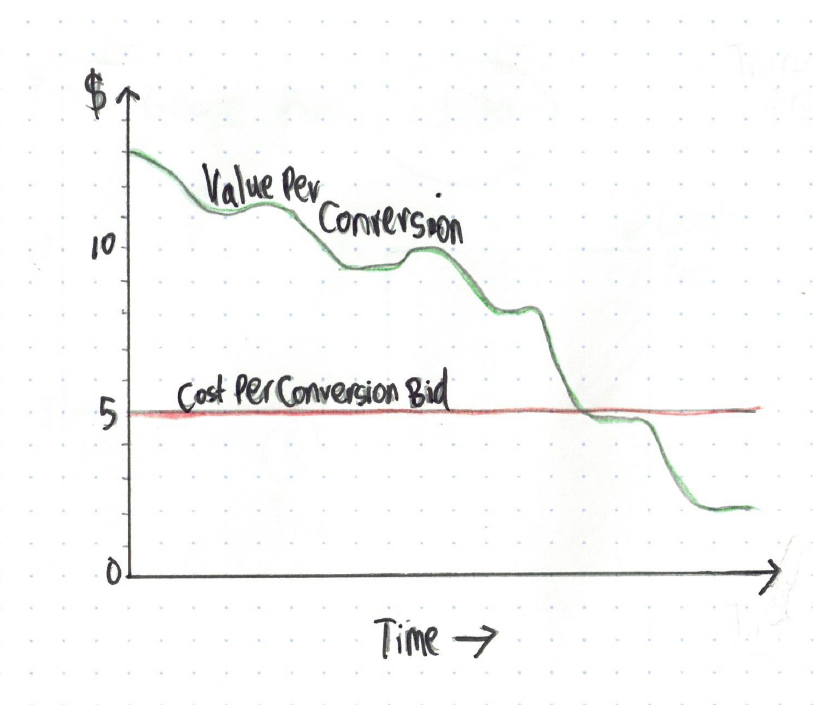
The longer your run your campaigns at a certain cost per conversion, the stronger your signal to Google that you’re generating sustainable profit at that cost per conversion.
What does Google do with this insight? The most likely outcome is progressively lower-quality traffic until you notice and make changes, then a slight backtrack to maintain you as advertiser while extracting maximum profit.
End result = declining campaign performance over time.
2. Your smart bidding history
The frequency, magnitude, and direction of your cost per conversion target.
If you increase your target ‘cost per conversion’ amount, this signals to Google that the value you expect to receive from additional customers exceeds the extra cost your are willing to pay for those additional customers. In other words, you’re telling Google that not only is your business happy with the current profit being received at the current cost per conversion, but that it’s likely to be more happy paying an even higher cost per conversion if additional customers can be delivered.
What does Google do with this insight? Well, knowing that you’re probably monitoring the impact of this change very closely, deliver a temporary higher volume of high-quality traffic to your business to deliver at least a proportionate increase in customers. This will cause you to logically conclude that the change was beneficial, and cause you to drop your guard as a result. Then, after a certain period of time, Google starts delivering progressively lower-quality traffic until you notice and make changes, then backtracks slightly to maintain you as advertiser while extracting maximum profit.
End result = declining campaign performance over time.
3. Your sales data
What you import into Google Ads via conversion tracking, Google Analytics, or using manual conversion imports.
If you tell Google which clicks generate sales, **you’re telling Google which clicks generate sales**. It’s as simple as that. What does Google do with this insight? The same again – start delivering progressively lower-quality traffic until you notice, then backtrack slightly to maintain you as advertiser while extracting maximum profit.
End result = declining campaign performance over time.
Smart Bidding Deteriorates Over Time
Long-term, smart bidding will always lead to declining campaign performance.
And why wouldn’t it? You’ve given complete control of your campaigns to Google who owns the auction and owns that market and represents your business and represents your competitors and is incentived to increase click costs of all advertisers to maximise its own collective profit. It’s a perfect storm.
You see, smart bidding gives Google incredible leverage over businesses:
- Smart bidding gives Google power to deliver high-quality traffic to businesses who are more sensitive of campaign perfomance (e.g. new businesses, or business who recently pulled back budgets), while saving money by delivering cheaper clicks to businesses who aren’t as sensitive to declining campaign performance (e.g. businesses with higher margins who set and forget their campaigns). End result = higher profits for Google, lower profit for businesses.
- Smart bidding gives Google power to deliver short-term improvements in performance when it detects a business is becoming more critical of campaign performance, in an attempt to ease the worries of those businesses and keep those businesses as long-term paying customers. End result = higher profits for Google, lower profit for businesses.
- Smart bidding gives Google power to take advantage of short-term noise and fluctuations to distract businesses from the underlying long-term behaviour at play. It’s relatively easy for a business to spot a sudden 50% drop in conversions overnight, but much harder for them to detect a 25% drop over a 12-month period. Businesses in the latter scenario might start asking questions such as: “What caused this drop? Surely it can’t be Google Ads, because I didn’t change anything? Is it seasonality? Is it interest rates?” Whereas in reality, it’s often a case of Google’s algorithm intentionally delivering progressively lower-quality traffic over a long enough time period and in a manner sporadic and volatile enough to confuse the rational theories of businesses and make it difficult for them to pinpoint the real cause of declining campaign performance. End result = higher profit for Google, lower profit for businesses.
Note that short-term, there may be volatility in campaign performance, since Google’s algorithm understands that businesses are more likely to assess the impact of bid and budget adjustments shortly after changes are made, therefore incentivising Google to demonstrate positive cause-and-effect during this short-term reflective period.
However, once this period lapses, and Google realises that the new strategy will likely remain in place long-term, Google will revert back to the same equilibrium: declining campaign performance.
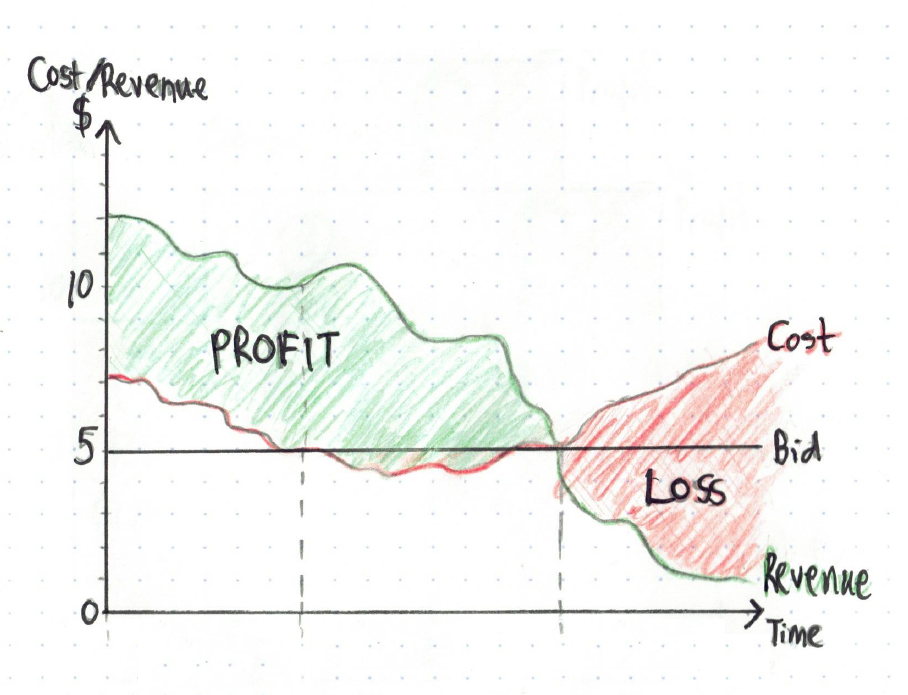
The long-term optimum for Google’s smart bidding is therefore not collective profit maximisation for businesses who advertise on Google, but rather collective profit extraction.
However, all is not lost! Luckily there are several ways for businesses to regain some leverage over Google, reduce their costs, and increase their profits.
Let’s explore 3 possible solutions.
Solution 1: Manual bidding
Use your own algorithms.
Several of my most successful campaigns for some of Australia’s leading brands use manual bidding algorithms. I’ve run AB split-tests for many clients, and have proven that on many occasions that manual bidding often delivers significantly higher performance than smart bidding.
Of course, manual bidding comes with its own inefficiencies. And in theory, all other things equal, Google’s smart bidding AI should be able to significantly out-perform any ‘manual’ bidding algorithm.
And this is probably the case. However, the key difference is that if Google’s bid strategy was able to deliver 80% savings using it’s AI technology, since Google has control over the costs you actually pay, Google may keep 70% of the savings to itself and only pass on 10% in terms of lower click costs.
Compare this to a ‘manual’ bidding algorithm which had a 4x worse cost-saving performance (e.g. 20% instead of 80%). Since all of those savings are passed to the business (20%), the cost savings are twice as high (20% compared to 10%).
What this means is that a manual bidding strategy can be terrible and still out-perform Google’s AI smart bidding, simply due to the dynamics of leverage, incentives, and balance of power.
Solution 2: Long-tail campaigns
Use thousands of keywords.
Long-tail campaigns have been a core foundation of almost every Google Ads strategy I’ve build over the last 18 years. They continue to significantly out-perform broader keyword strategies due to increased control, increased reporting granularity, and the ability to ‘funnel’ higher-intent search queries to cheaper, more-specific keywords using campaign negative filters.
Long-tail campaigns also allow a greater number of tailored ads to achieve higher click through rates and higher impression share, and allow visitors to be taken to different pages to increase conversion rates and return on investment.
Solution 3: Manual sales analysis
Keep your sales data secret.
Do not import your sales data into Google Ads. Instead, install GCLID (google click ID) tracking, pass the GCLID value through your enquiry form or checkout, and store internally in your sales data or CRM.
You can then extract GCLID data from the Google Ads API, match up your sales and enquiry data, and conduct your own analysis in Microsoft Excel or Google Sheets to identify differences in performance within your campaigns.
These insights can then be fed into your Google Ads campaigns via bid, budget, and keyword adjustments without sharing any data with Google, keeping Google in the dark as to value of different keywords to your business, skewing the campaigns significantly in your favour.
As an example, in February 2026 I carried out a GCLID analysis for an automotive client in Australia, and found that 31% of Google spend was accounting for only 7% of sales, desite a similar cost per enquiry. Because the account had a long-tail structure, it was possible to add a handful of negative keywords to exclude wasteful spend without cannibalising other keywords in the campaign, and reallocate spend to more productive keywords which had a higher follow-through to sale. After only a single month, the client saw a 27% increase in sales despite a 2% lower spend.
Free 60-Minute Consultation
If you’re an Australian business and keen increase your sales, revenue, and return on investment from Google Ads, please get in touch today for a free 60-minute consultation.